Configure
Select objects and fields, then assign an appropriate masking strategy to each field.
Salesforce · Apex · LWC · Governance
A safety-first Salesforce application for configuring masking strategies, previewing expected changes, and executing governed masking runs.
01 / The problem
Salesforce teams need realistic non-production data to test integrations, automation, reporting, and user workflows. Copies of production data can also carry names, email addresses, telephone numbers, and other information that should not remain recognizable.
The challenge is larger than replacing a few fields. Administrators need a repeatable way to define masking behavior, understand the scope, preview the outcome, control who may execute it, and preserve enough evidence to support governance and troubleshooting.
Product walkthrough
These views show how OOPS separates configuration, preview, and execution so administrators can understand the scope before authorizing a data-changing operation.
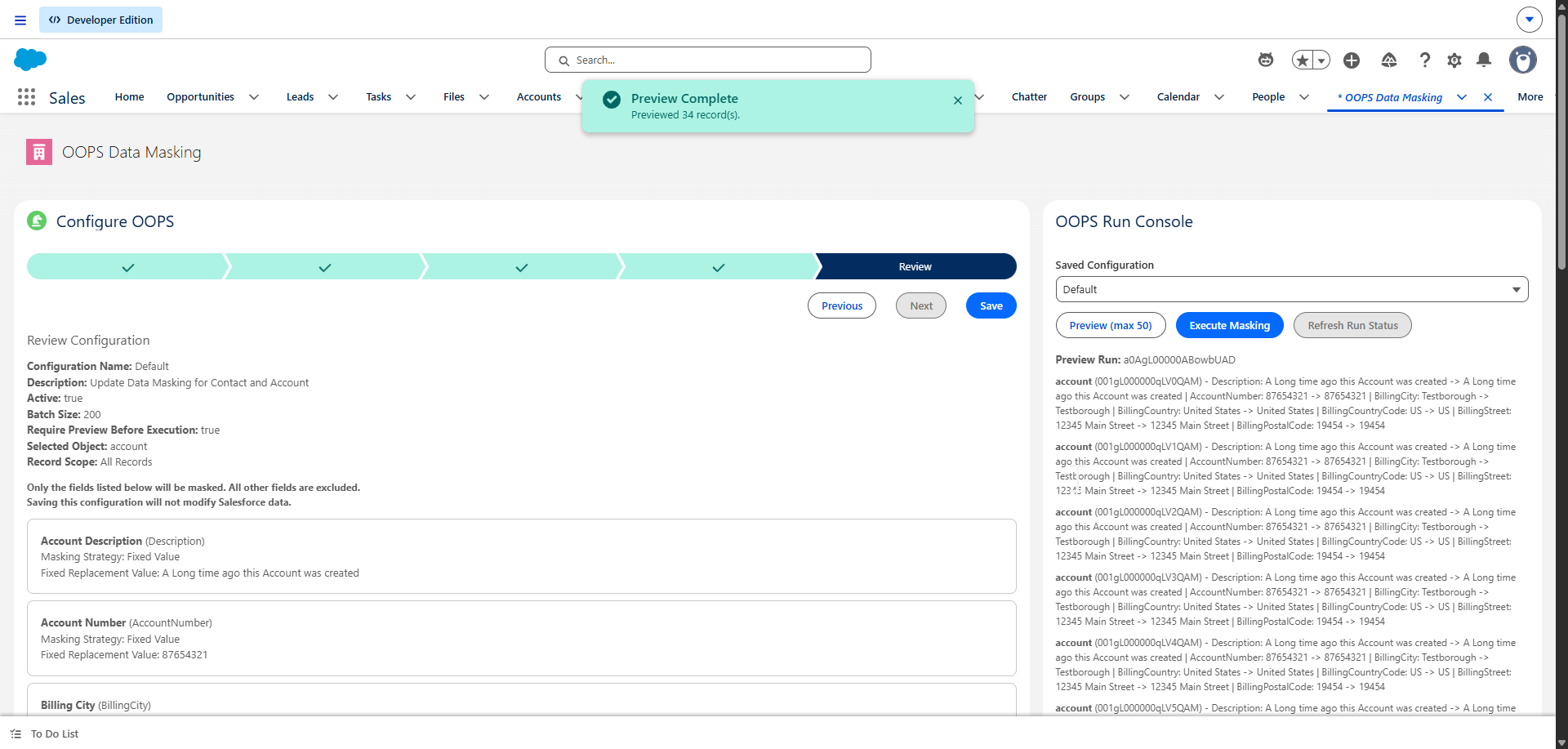
OOPS configuration review and completed preview. Administrators can inspect the selected scope and proposed transformations before authorizing any Salesforce record changes.
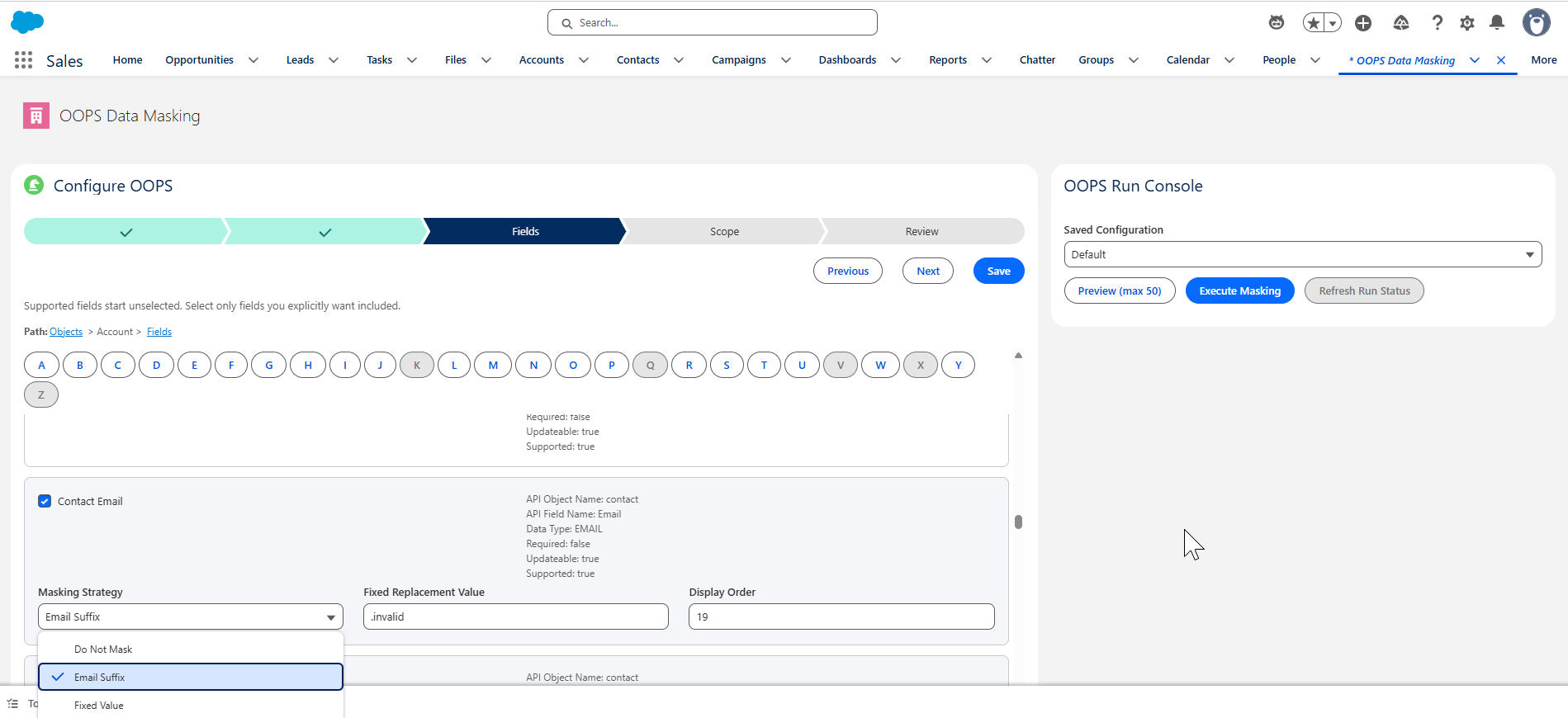
Configuring the Contact Email field to use the Email Suffix strategy, replacing the domain with .invalid.
Operating flow
Select objects and fields, then assign an appropriate masking strategy to each field.
Review expected transformations before Salesforce records are changed.
Confirm the environment, permissions, scope, and explicit execution safeguards.
Run masking through controlled processing with exceptions and results captured for review.
Provide a governed record of what ran, what changed, and what requires attention.
Safety architecture
OOPS does not rely on a warning label and crossed fingers. Its controls work together to reduce accidental or unauthorized execution.
Normal operation is designed for sandboxes. Production use is treated as an exceptional, controlled scenario.
Production requires two permissions, an enabled configuration setting, and explicit console confirmation.
Administrators can inspect expected masking results before committing to a data-changing operation.
Execution rights are deliberately separated from general application access.
Masking runs and exceptions create an operational record instead of leaving administrators to reconstruct events afterward.
Run history can be purged after a defined retention period to keep operational data manageable.
Architectural decisions
Governance
Masking is valuable precisely because it changes sensitive data. OOPS treats production execution as an exception that must pass multiple independent controls—not as a convenient checkbox.
Usability
Environment banners, preview results, typed confirmation, and plain-language warnings keep consequences visible at the point of action.
Scale
Administrators define reusable masking behavior while processing handles record scope and results. This keeps the experience understandable as the number of objects and fields grows.
Operations
Run records, exception handling, reporting, and retention matter because a production-quality tool must explain what happened after the button was pressed.
Technical shape
Administrator-facing components for configuration, preview, execution status, warnings, and results.
Server-side orchestration for field strategies, scoped processing, validation, exception capture, and governance controls.
Settings and metadata-driven controls keep operational choices outside hard-coded execution paths.
Masking runs and exceptions provide traceability, reporting, and a foundation for retention management.
Critical operating constraint
OOPS is designed for normal use in a sandbox. The production override exists only for controlled testing and exceptional scenarios, with formal authorization and layered controls.
Project links
Watch the complete walkthrough or inspect the public source code, documentation, and safety guidance.